


Systemic Neglect: Celestia Quixs’ Struggle for Care
Explore systemic medical neglect and family exploitation faced by Celestia Quixs, revealing the emotional toll of institutional failures.
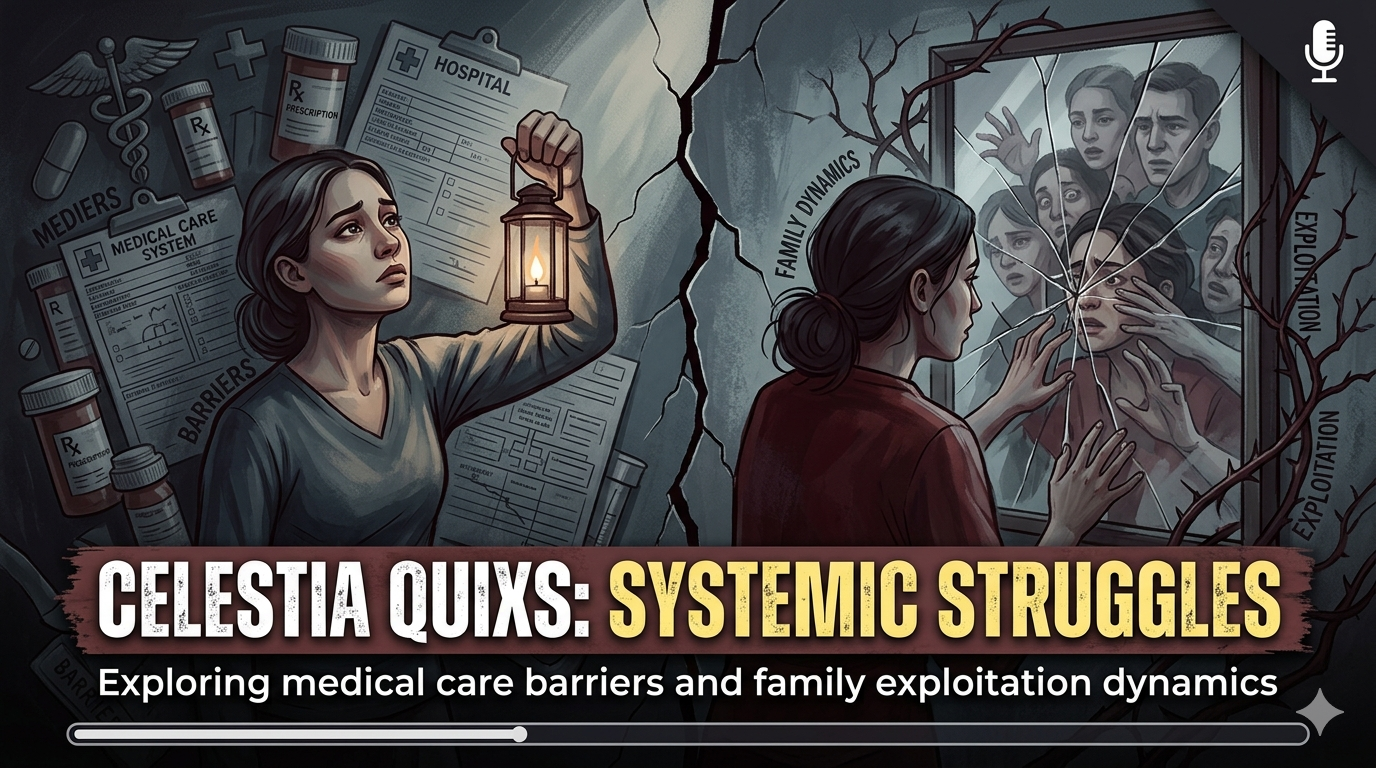
This episode explores systemic issues faced by Celestia Quixs, highlighting struggles for medical care within harmful systems and family exploitation dynamics. It emphasizes the lack of genuine advocacy and the emotional toll of institutional failures, portraying a reality where vulnerable individuals bear the consequences while effective support remains elusive.
- The post promotes Episode 6 of Celestia Quixs’ CQ DX Podcast, focusing on her personal encounters with systemic medical neglect, family financial exploitation of SSDI funds, and resulting emotional isolation.
- Key issues covered include national EHR blacklisting via flags like “litigious” or “resource-intensive,” late diagnoses of conditions such as Level 1 Autism and terminal pulmonary disease, and family scapegoating dynamics spanning decades.
- As a writer and advocate, Celestia Quixs frames these institutional and relational failures as part of broader systemic breakdowns that leave vulnerable individuals without meaningful solutions or support.
Pip: Celestia Quixs — pronounced KEEZ — has been putting the receipts on the table for so long that the table itself is now evidence.
**Mara:** This episode covers three territories from Celestia Quixs: the experience of fighting for medical care and basic survival inside systems designed to deny both, the family dynamics that compound that isolation, and the question of what it means to advocate when the mechanisms meant to help are either broken or actively harmful. Let’s start with the medical neglect and exclusion at the center of all of it.
When the System Decides You Are Not Worth Treating
Pip: The frame here is a question about what happens when every institution a person depends on — medical, legal, familial, governmental — reaches the same conclusion at roughly the same time.
**Mara:** The post on systemic medical neglect opens with the person’s own words in a conversation with an AI: “I need someone to talk to. But I am afraid to talk to anyone anymore because everyone thinks there must be a solution to every problem. No one will just sit with me in the reality that there are no solutions.”
**Pip:** That sentence does a lot of work. It is not a request for help. It is a description of what help has become — a mechanism for other people to exit the room.
**Mara:** The post documents a pattern that runs across every system the person encounters. In the healthcare context specifically, the Electronic Health Record flags — “litigious,” “resource-intensive” — travel through Epic’s Care Everywhere framework nationally. A 2021 tag from a Kansas provider follows the person to Nevada before they even arrive, because of a merger between SCL Health and Intermountain that pulled the records in advance of the system’s Go-Live.
**Pip:** The EHR is supposed to coordinate care. In this case it coordinates something else.
**Mara:** The post on Fighting to Breathe puts it in plain arithmetic. The person needed a fifty-pound oxygen concentrator moved four feet. It took a twenty-minute argument. The post frames this as one instance in a pattern: “They redefine the request. They gaslight about reality. They prioritize their comfort over my survival.”
**Pip:** The Compliance Trap post maps the structural version of that same dynamic at scale — what happens when the data silence created by a medical blacklist gets read by SSA’s automated auditing system as evidence of health improvement, triggering benefit termination, retroactive overpayment, and then a Treasury levy on every account tied to the person’s Social Security number. No court order required.
**Mara:** The post describes this as a closed loop: “The circuit is flawless, automated, and lethal. The HIE gatekeeper cuts off care. The SSA AI uses data silence to strip income. The EM-26005 REV Treasury centralization drains liquid assets. Executive Order 14321 uses the resulting homelessness to execute permanent physical confinement.”
**Pip:** And the post on why diagnostic acronyms get used adds the layer underneath all of it — the person is a late-diagnosed Level 1 Autistic, CPTSD, hypermnesia, multiple terminal pulmonary conditions, medically blacklisted, and still describing herself as someone whose life is an epic, not a tragedy.
**Mara:** The CQ DX Podcast Episode 5 post pulls the arc together across the healthcare and identity verification territory — ID.me failures, algorithmic benefit termination, clinical blacklisting — and names the consistent thread: systems designed to serve access functioning instead as gatekeepers, with the people who have the least institutional leverage carrying the full cost of every failure.
**Pip:** The Confronting Isolation post lands that cost in a single moment — the person sitting alone in the chat at her own album premiere, her ex-husband in the same unit, not watching. That’s the segment heading, not a metaphor.
That’s the medical and institutional picture. The family dimension is where it started.
The Family Fund and the Scapegoat Role
Pip: The question in this territory is how a family system can function, over decades, to extract resources from one person while making that person responsible for the extraction.
**Mara:** The Understanding Family Exploitation post documents the mechanics directly. The person paid seventeen thousand dollars from her SSDI over sixteen years, believing she was repaying a probate debt into a shared family fund her father had requested. The fund was opened after her father died, funded entirely by her payments, and used by family members for plane tickets, a wedding dress, and a five-thousand-dollar condo down payment by the sister who served simultaneously as the person’s SSDI payee and executor of the estate.
**Pip:** That’s a conflict of interest with a paper trail.
**Mara:** The SSA audited and found no legally defined exploitation, because the payments were classified as voluntary probate repayments. The post notes that when the person asked for the financial books, the sister refused, citing her role as executor — the same role that created the conflict.
**Pip:** The Why I Use Diagnostic Acronyms post puts the family context in a longer frame: lifelong family scapegoating abuse beginning at age three, hypermnesia that retains it all word-for-word, and a CPTSD diagnosis that the healthcare system declined to treat with the trauma-based IOP a therapist identified as necessary — because nicotine use doesn’t qualify as a substance use disorder under the intake criteria.
**Mara:** The Confronting Isolation post connects the family pattern to the present: the roommate who didn’t watch the album premiere is the ex-husband of thirty-plus years, who knows the specific wound — a mother telling a thirteen-year-old to stop singing because she didn’t need her being happy around there — and recreated it on the night of the person’s final album release.
**Pip:** The Manufactured Eunuch post sits adjacent to this territory — it’s a structural analysis of how economic shaming, forced clinical intake, and SSRI prescribing interact to produce what the post calls the permanent erasure of male agency. It’s the one piece here that steps back from the personal and maps a dynamic in the abstract, though the observation about who gets blamed for the output applies across the board.
The family picture and the medical picture both feed into the third territory — what advocacy looks like when the systems meant to respond have already decided not to.
Warning Without Acting Is a Business Model
Pip: The Advocacy Gaps post starts with a simple question directed at an attorney with a large YouTube following who has been warning SSDI and SSI recipients about automated benefit cuts: what is he actually doing to stop this, beyond the warning?
**Mara:** The post is direct: “Is he going to represent any of us in a restoration of benefits case? Is he speaking to his colleagues in his legal society or the State Bar and rallying them to prepare for an influx of cases?” The post frames the warnings as fear-based content that monetizes the anxiety of people who cannot rally, lobby, or organize because they are too ill to leave their homes.
**Pip:** The person filing grievances to CMS and HHS OIG, reaching out to law firms and investigative journalists, and getting back the same answer — we cannot compel a doctor to treat you — while the attorney posts videos is a particular kind of asymmetry.
**Mara:** The Preparing for Collapse post extends the analysis. It connects the agricultural threats, the healthcare blacklisting infrastructure, the DOGE AI sweeps, and the civil commitment pathways under Executive Order 14321 into a single argument about who ends up warehoused when the systems finish their work — and who has already positioned to manage that population.
**Pip:** The AADJ v. Epic class action gets mentioned in the Advocacy Gaps conversation as the one visible legal effort in this space — and the post points out that it focuses on applicants trying to get approved, not on people already in the system with propagating flags that cause providers to avoid the record entirely without technically blocking access to it.
**Mara:** The distinction the post draws is precise: the records travel via Care Everywhere. The flags travel with them. Providers see the flag and decline to engage deeply enough to become ethically bound. That’s not information blocking. That’s plausible deniability at scale.
Pip: What stays with me is the phrase from the medical neglect post — “no one will just sit with me in the reality that there are no solutions.” That’s the ask. Everyone keeps handing back a solution. **Mara:** The next episode will have more from Celestia Quixs. The record keeps going.
Related Essays:
- Understanding Family Exploitation
- Advocacy Gaps
- 🌀 The Manufactured Eunuch
- Confronting Isolation
- 🚨 The Compliance Trap
- Preparing for Collapse
- Navigating Healthcare Frustrations & My Battle with 2FA Issues
- Why I Use Diagnostic Acronyms
- Navigating the Complexities of Systemic Medical Neglect
- FIGHTING TO BREATHE
Discover more from Celestia Quixs™
Subscribe to get the latest posts sent to your email.