
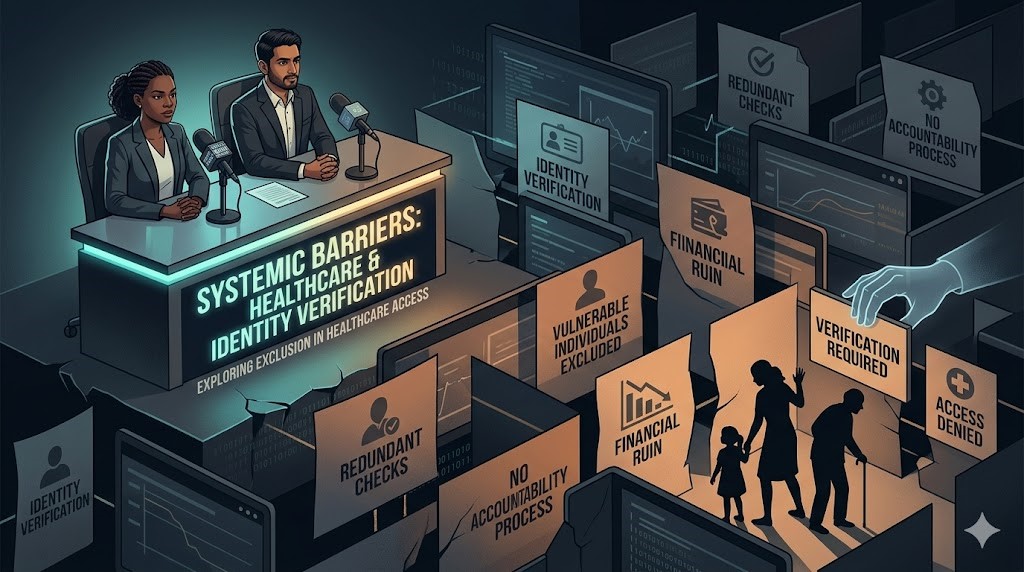


Celestia Quixs’ podcast team explores how healthcare and identity verification systems hinder access for vulnerable individuals. Highlighting redundant verification and accountability issues, the podcast argues that these systems effectively exclude people from essential care. It also details a mechanized process leading to financial ruin and exclusion, exacerbating the struggles of those already marginalized.
Pip: Celestia Quixs is writing the kind of content that makes you realize your biggest bureaucratic complaint — the DMV, probably — was actually fine.
Mara: This episode covers two territories from Celestia Quixs: how healthcare and identity verification systems obstruct access for the people who need them most, and how automated financial and medical infrastructure erases chronically ill individuals from the safety net entirely. Let’s start with the verification wall.
Navigating Healthcare Barriers: Identity Verification Challenges
Explore how healthcare and identity verification systems exclude vulnerable individuals from essential care, causing financial and health crises.
When “Verify Once” Means Verify Again and Again
Pip: The promise of ID.me’s core model is right there in the name — verify once, use everywhere. The post documents what happens when that promise collides with a broken liveness check and a support team running on scripts.
Mara: The post quotes ID.me’s own platform directly: “Once you complete identity verification, your verified credentials are saved in your ID.me Wallet. You can then use your existing login and Multi-Factor Authentication to access your identity across federal and state agencies, healthcare providers, and retail partners without re-verifying.”
Pip: So the user is already verified at the federal level for SSA and USPS, and is now being forced through a redundant liveness check for a retirement portal — one that fails on two separate devices, two browsers, incognito mode, cleared cache, the works.
Mara: The post documents four specific failure points: the liveness check never connecting to cameras on either device, the support agent refusing to escalate to a human Trusted Referee, management declining to provide a ticket number, and the chat interface destroying the transcript record by design — no download, no email, no submission confirmation.
Pip: That last one is doing a lot of work. A system that won’t generate a ticket and won’t preserve a transcript isn’t a support system — it’s a paper shredder with a chat window.
Mara: The post frames this as a vendor accountability issue directed at SDCERA and other contracting agencies. It also connects to the broader argument in The Silent Sentinel, which examines how the 21st Century Cures Act’s interoperability framework has enabled nationwide do-not-treat flags — turning the same infrastructure meant to coordinate care into a mechanism for permanent exclusion. Both posts and the CQ DX Podcast episodes covering this territory reach the same conclusion: the system classifies, moves on, and leaves the person to carry the error.
Pip: The verification wall and the clinical blacklist are different doors into the same locked room. Which is exactly where the next piece picks up.
The Automated Disappearance Pipeline
Pip: The Algorithmic Execution maps what happens after the locked door — a four-phase sequence that converts a medical blacklist into financial ruin, then physical removal, without requiring a single human decision along the way.
Mara: The post is explicit about the mechanism: “federal regulatory oversight bodies like CMS and HHS OIG possess no statutory authority to compel an individual physician or private network to provide treatment, the synchronized database tag functions as a permanent, unappealable blockade.”
Mara: The consequence is structural. Phase one cuts off care. Phase two weaponizes the resulting data silence — the SSA’s auditing AI reads the absence of new medical records as clinical improvement and terminates benefits retroactively, with the notice arriving after the appeal window closes.
Pip: The author writes as a retired HHSA insider currently in phase two. The argument is that professional institutional literacy provides zero protection against automated purging — which makes the mechanism absolute, not incidental.
Mara: EM-26005 REV closes the financial exit. It centralizes benefit delivery under a direct Treasury pipeline, so the retroactive overpayment becomes an immediate levy on every account tied to the Social Security number — pensions, retirement distributions, everything — with no court order required. Navigating Chaos documents the lived texture underneath all of this: the shrinking window of calm, the mycotoxicosis, the creative work — music composition, published essays — as the only available recourse when every institutional door is closed.
Pip: The system waits, the clock runs, and the person builds a legacy in a hundred and sixty square feet. That’s not a policy failure. That’s the policy.
Mara: The thread across both segments is the same: systems designed to serve access are functioning instead as gatekeepers, and the people with the least institutional leverage carry the full cost of every failure.
Pip: Verify once. Flagged once. Gone. There will be more to cover next time.
- CelestiaQuixs promotes Episode 4 of the CQ DX Podcast, focusing on how healthcare and identity verification systems exclude vulnerable people through redundant processes and technical failures like broken liveness checks in ID.me.
- The episode describes an “automated disappearance pipeline” where medical blacklists, data gaps, and SSA auditing lead to retroactive benefit terminations and account levies without court orders, referencing policies like the 21st Century Cures Act and EM-26005 REV.
- As a retired HHSA insider experiencing mycotoxicosis, the author uses personal context to highlight systemic barriers that block care and financial stability for affected individuals.
Related Essays:
ID.me’s “Verify Once, Use Everywhere” is failing
Discover more from Celestia Quixs™
Subscribe to get the latest posts sent to your email.