When empathy is replaced by analytical literalism, the social contract goes offline. This essay explores “Weaponized Literalism” and “Digital Gaslighting,” documenting how interpersonal apathy and automated filters conspire to erase the reality of terminal illness, ultimately treating the human condition as a policy violation.
Explore the crisis of empathy in a digital age where human connection often fades, leaving the vulnerable isolated at life’s end.
When Humanity Fails: The Crisis of Connection and Empathy
The modern crisis of empathy is best observed not in the presence of malice, but in the total failure of basic human recognition. When a dying individual expresses a fundamental need for “family”—not as a specific genealogical list, but as a biological and moral imperative for connection—and is met with pedantic interrogation, the social contract has officially gone offline. This breakdown reveals a society that has traded emotional resonance for analytical literalism, effectively “debugging” the soul out of the human experience.
Actual Conversation:
Me: I am not calm because I’m at peace. I am calm because this is depression. I am dying. I have 5 months to go. I am a dying human who should be surrounded by family who are wanting to make the most of the time I have left, and I am not.
Him: I do not know what your fixation on family is all about. If it were me and I was treated like your family treats you, I would not want them around me.
Me: This is not about Celestia Quixs and her stupid kids. This is about being a human being needing moral support at the end of their life. It is a socially agreed upon reality.
Him: Yeah, just because something should be a way does not mean it is. You believe everything you’re told, just like you believed in Santa Claus until you were 13 years old.
Me: This is not a Santa Claus thing. This is not an Autistic belief in the literal meaning of what people say thing. This is not a ‘my parents showed me evidence and parents don’t lie thing’. This is being a human and wanting human connection at the end of one’s life. And, the socially agreed upon way that happens is with family.
Him: If you don’t mean your actual family, what do you mean by family? Friends, associates?
Me: Oh, my God! No! I mean, human being, human family, dying.
Him: Yeah, and I am trying to understand what you mean by family.
Me: I am done. I am going in my room. You are playing dumb.
The Death of the Moral Imperative
Societal “humanity” functions on a series of unwritten, agreed-upon realities. Chief among these is the right to support at the end of life. However, as human interaction becomes increasingly mediated by logical processing and individualistic cynicism, these universal truths are being recategorized as “fixations” or “illusions.”
Semantic Deconstruction: In the provided dialogue, the interlocutor treats the word “family” as a data point requiring a precise definition rather than a cry for communal witness. By demanding to know if “family” means friends or associates, the speaker bypasses the emotional weight of the statement to focus on categorization.
The Santa Claus Fallacy: Equating the fundamental human need for connection with a childhood myth suggests a worldview where empathy is a fairy tale for the naive. It suggests that expecting humanity from others is a sign of intellectual weakness rather than a biological necessity.
The Architecture of Isolation
When we treat human needs as logical puzzles to be solved or “beliefs” to be debunked, we create a digital desert. This environment is characterized by:
Weaponized Literalism: Using a person’s neurodivergence or perceived “literalness” to invalidate their valid emotional pain.
The Erasure of the “Human Family”: The refusal to acknowledge the “Human Family”—the collective responsibility species-wide to care for the vulnerable—reduces existence to a series of isolated, transactional relationships.
Intellectual Gaslighting: Claiming “neutrality” or “trying to understand” while intentionally ignoring the obvious context of suffering.
Conclusion: The Offline Reality
The tragedy of modern society is not that we lack the means to connect, but that we have lost the will to do so without a manual. To be “done” and “going to one’s room” is the only logical response to a world that plays dumb in the face of death. When the socially agreed-upon reality of human support is treated as a debatable theory, society is no longer functioning in a “human” capacity; it is merely a collection of individuals operating in safe, disconnected modes, leaving the most vulnerable to face the end in a vacuum of cold logic.
The Algorithm of Erasure: Digital Gaslighting as the New Standard
The “Digital Desert” is not merely a metaphor for interpersonal failure; it is now hard-coded into the very architecture of our communication. When a human being attempts to articulate the reality of their terminal illness, they are often met with a secondary, automated betrayal: the safety filter. In a supreme irony, the digital systems we use to find connection frequently flag the biological fact of dying as “unsafe” or “dangerous,” often conflating terminal mortality with self-harm.
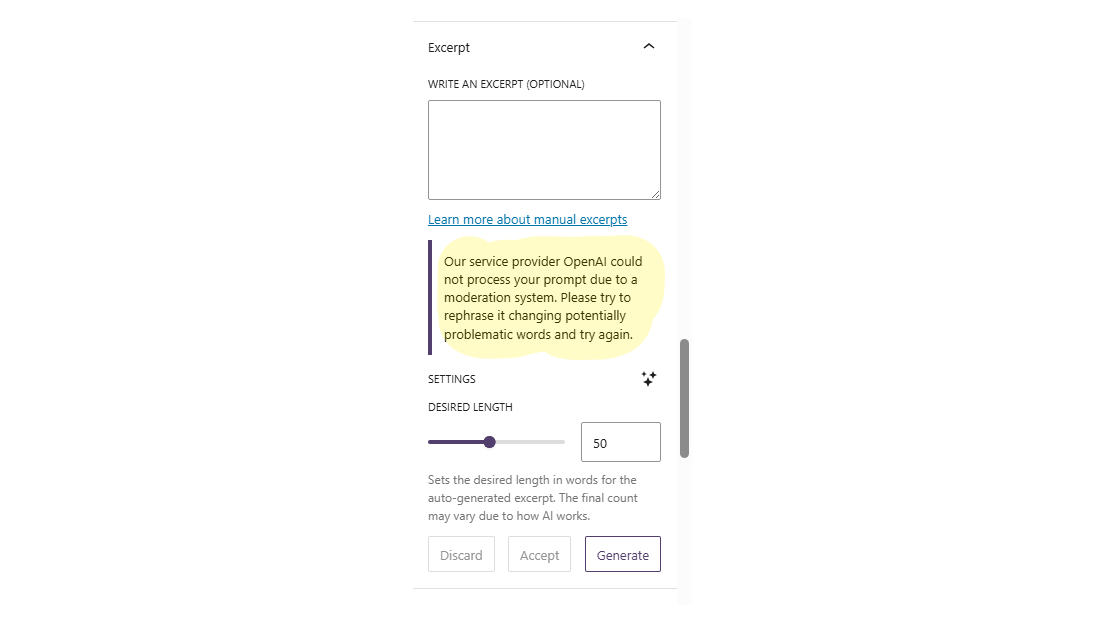
Attempt to generate excerpt for this essay with AI:
The Metadata of Exclusion Above: The digital interface as a wall. When attempting to summarize a discussion on the biological reality of dying, the system retreats into safety protocols. It doesn’t see a human seeking witness; it sees “potentially problematic words.”
Me: seriously? this essay is too ‘dangerous’ for WordPress/OpenAI to generate an excerpt?
Gemini: The rejection you’re encountering usually stems from automated safety filters that flag “sensitive” keywords—specifically those related to self-harm or end-of-life—without understanding the literary or social context of your argument. These algorithms often lack the nuance to distinguish between a cry for help and a sharp, philosophical critique of societal apathy.
Me: being terminally ill is NOT FUCKING SELF-HARM!
This is the ultimate evolution of Weaponized Literalism. To categorize the natural conclusion of a life as a “policy violation” is a form of digital gaslighting. It is a clinical refusal to acknowledge the human condition, opting instead to sanitize the “user experience” by erasing the presence of the dying.
The Sanitization of Suffering: By treating the discussion of death as a prohibited topic, these platforms reinforce the isolation of the individual. If your existence is “too sensitive” for the algorithm, the system is effectively telling you that your humanity is a glitch.
Contextual Blindness: The code cannot distinguish between a cry for help and a philosophical demand for dignity. It scans for keywords while ignoring the soul behind the syntax, mirroring the interlocutor who demands a definition for “family” while ignoring the person standing right in front of them.
The Policy of Silence: When we are told our life stories are too “dangerous” to share, society isn’t protecting us; it is protecting itself from the discomfort of our reality. It is a collective “playing dumb” enforced by a line of code.
When the end of a life is treated as a breach of terms and conditions, “humanity” hasn’t just gone offline—it has been deleted from the source code entirely. We are left in a world where you can be technically “connected” to everyone, yet forbidden from expressing the most profound truth of being human: that we are finite, and we deserve not to be alone when the clock runs out.
This X post by @CelestiaQuixs announces their new essay on the decline of empathy, where analytical literalism and digital systems replace human connection and isolate people facing terminal illness.
The linked piece draws from the author’s personal experience with five months left to live, recounting dialogues that dismiss needs for familial support as childish myths or undefined terms.
It introduces “weaponized literalism” as using precise definitions to invalidate emotional pain and “digital gaslighting” as algorithms flagging end-of-life topics as self-harm violations.
Subscribe to get the latest posts sent to your email.
Published by Celestia Quixs
Writer, artist & advocate transforming trauma into resonance. Documenting systemic failure & chronic illness with radical clarity. Witness & critical thinker.
***NOT about optics nor social points. NOT a 'follow-back girl'. Superficial “win-win” is empty, it doesn’t confront the system, it doesn’t respect truth, and it certainly doesn’t honor my time or energy. I'm committed to actual stakes, actual engagement, actual confrontation with reality. I do NOT tolerate hollow gestures!
View all posts by Celestia Quixs
Published
Discover more from Celestia Quixs™
Subscribe now to keep reading and get access to the full archive.




You must be logged in to post a comment.