
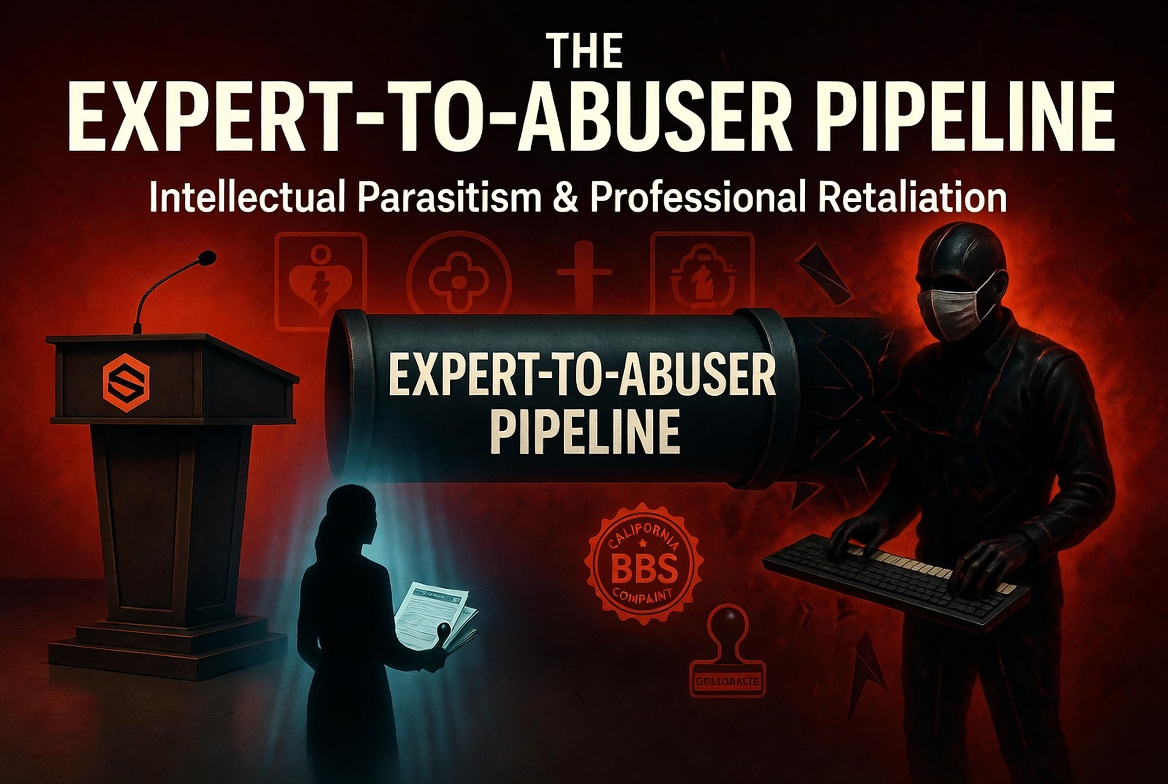


When ‘Professionals’ Pathologize Survivors
How trauma experts Rebecca Mandeville and Sam Vaknin turned private help requests into public character assassination — documented retaliation exposed.
Intellectual Parasitism & Professional Retaliation
When trauma “experts” receive a survivor’s documentation and respond with public pathologization, it reveals the expert-to-abuser pipeline. This timeline of professional retaliation by Rebecca C. Mandeville and Sam Vaknin shows how credentials can weaponize plausible deniability against the very people they claim to help.
In the field of trauma recovery, a predatory pattern of professional behavior has emerged: the receipt of public documentation regarding a victim’s life-threatening reality, followed by the publication of content that pathologizes that individual. To protect themselves, these professionals refrain from explicitly naming the target, relying on plausible deniability to claim their content is “general education.” However, the chronological sequence of events—moving from the receipt of public documentation to public vilification—proves these actions are not coincidental. I have documented this sequence with Rebecca C. Mandeville and Sam Vaknin.
I. The Mandeville Case: Public Pathologization Following a Private Inquiry
The following timeline is established by the records associated with my formal grievance filed with the California Board of Behavioral Sciences (BBS):
- February 11, 2025: I subscribed to Rebecca C. Mandeville’s Substack, seeking support for family scapegoat abuse and the systemic barriers I face.
- February 13, 2025: I sent a private message to Mandeville asking for professional referrals: “Hello, Rebecca, Do you have a colleague in the Las Vegas Metro area you can refer me to?”
- The Miscommunication: She responded by questioning my location and asking if I had read her book that includes a section on finding a therapist. I replied: “If you had read my one-sentence DM, you would know where I am located. And, I would not subscribe to an author’s forum, if I had not first read their book.”
- The Pushback: Mandeville responded that she was “going through a lot right now” and found my tone offensive. I offered a constructive boundary: “I am sorry you are going through this. However, and I am not trying to tell you how to run your business; but, if I were going through a stressful situation, I would consider putting my social accounts on ‘vacation mode’.”
- The Accusation and Retaliation: Mandeville accused me of treating her like her abusive family and banned me from her community.
- February 15, 2025: Two days after the interaction, Mandeville published the article “The Rise of Aggression in Online Spaces,” ensuring the link arrived in my inbox. This article remains live on her Substack.
- The Character Assassination: In the article, she used a distorted version of our exchange to characterize a request for professional accountability and a suggestion for digital boundaries as “aggression,” shielding herself behind a “general topic” while targeting a specific individual.
- The Measured Response: After she publicly vilified me, I began a three-day period of cost-benefit analysis regarding the necessity of a formal grievance.
- February 18, 2025: I filed a grievance with the California Board of Behavioral Sciences (BBS Complaint #2002025001982) regarding her conduct.
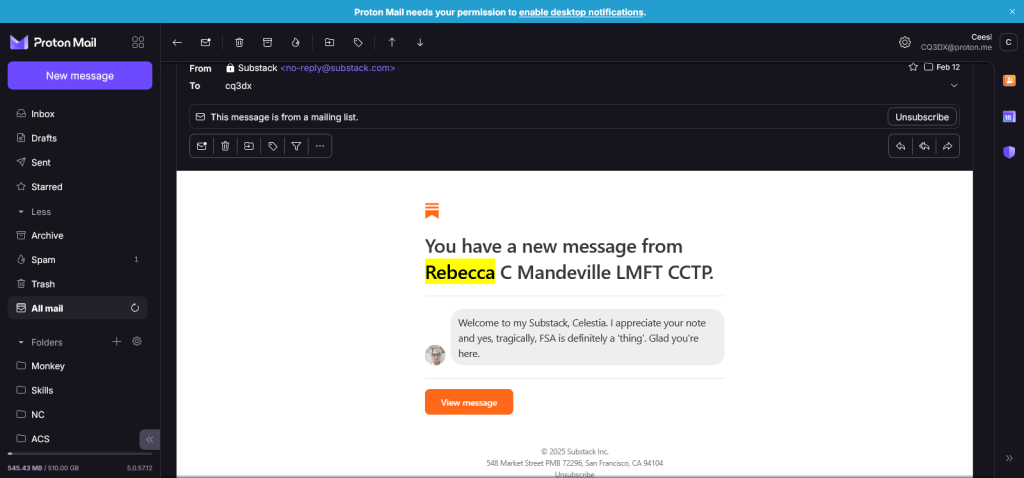
In response to my DM, “Hello, Rebecca, Do you have a colleague in the Las Vegas Metro area you can refer me to?” She sent the following:

My response was, “If you had read my one-sentence DM, you would know where I am located. And, I would not subsribed to an author’s forum, if I had not first read their book.” She replied:

I replied, “I am sorry you are going through this. However, and I am not trying to tell you how to run your business; but, if I were going through a stressful situation, I would consider putting my social accounts on ‘vacation mode’.”


“Today I banned a new paid subscriber from my Substack based on an interaction we had in my Direct Messages… when someone crosses the line by becoming hostile, aggressive, and/or abusive… I will not be ‘working through’ anything therapeutically… that subscriber will be banned… There will be no discussions about it, nor will there be any second chances.”
— Rebecca C. Mandeville, “The Rise of Aggression in Online Spaces” (published February 15, 2025 — two days after our DM exchange)


This article is still live on her substack: https://familyscapegoathealing.substack.com/p/the-rise-of-aggression-in-online-spaces
Analysis of Intent & Temperament: This was not an instance of a “troll” treating a provider the way her family treats her. This was a distressed autistic person with CPTSD and MDD reaching out for professional help while maintaining civility. The contrast in temperament is undeniable: while the provider was likely already writing her impulsive character assassination within 48 hours of a minor DM exchange, I took the next three days to soberly evaluate the situation before responding with a professional formal complaint and unaltered legal documentation.
The Erasure of Defense: It is important to note that the primary reason I do not possess screenshots of my side of this dialogue is that Mandeville immediately terminated my access by banning me. This is a common tactic in professional retaliation: the professional utilizes their platform to curate a public narrative of “aggression” while simultaneously deleting the victim’s ability to access the evidence of their own civility.
In a state of systemic collapse, a survivor has no reason to assume they will need to screenshot a simple request for help as a “defense” until the provider has already initiated the attack and erased the record. For a person with HSAM, the memory of the exchange remains in sharp detail, even when the digital receipts are intentionally withheld.
The Refusal of Repair: There has been no attempt at professional repair. A simple apology—acknowledging her state of distress and rescinding the ban—would have resolved the conflict. Instead, she chose to maintain the exclusion and the public vilification, cementing a pattern of maintaining professional image at all costs.
II. The Vaknin Case: Inversion of Reality and Medical Weaponization
The sequence involving Sam Vaknin moved from a cordial professional exchange to a targeted public mocking of a terminal medical condition:
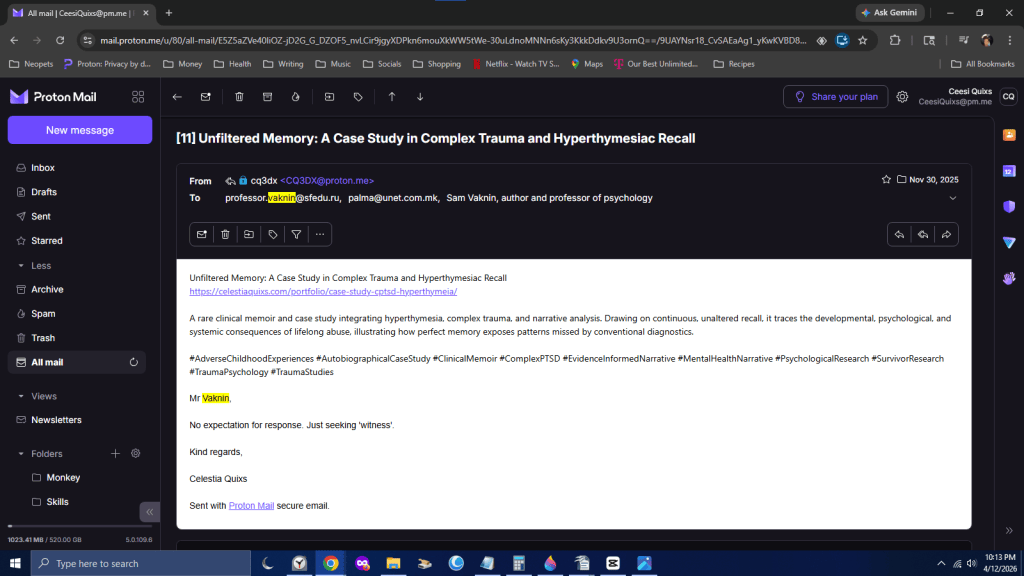
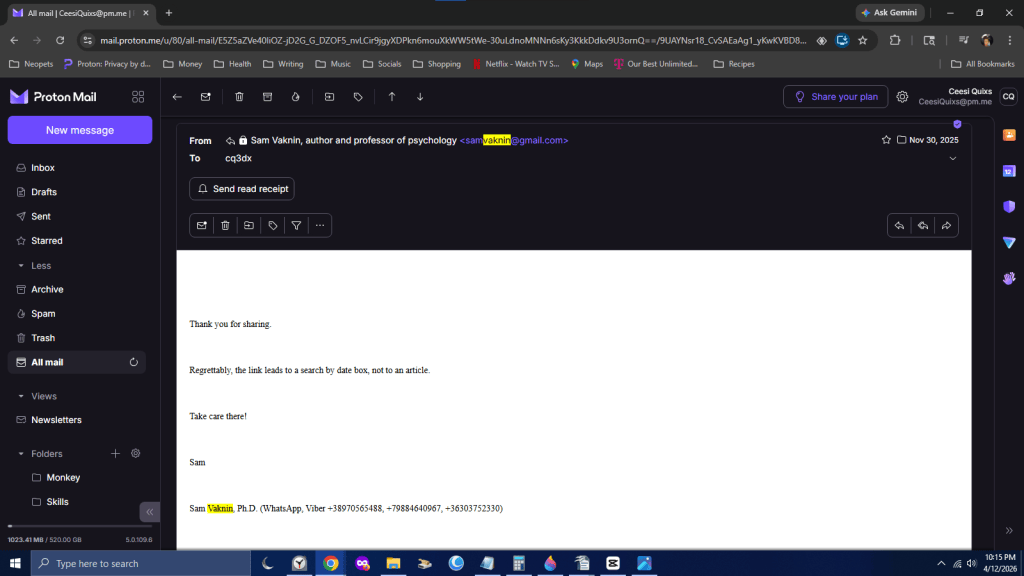
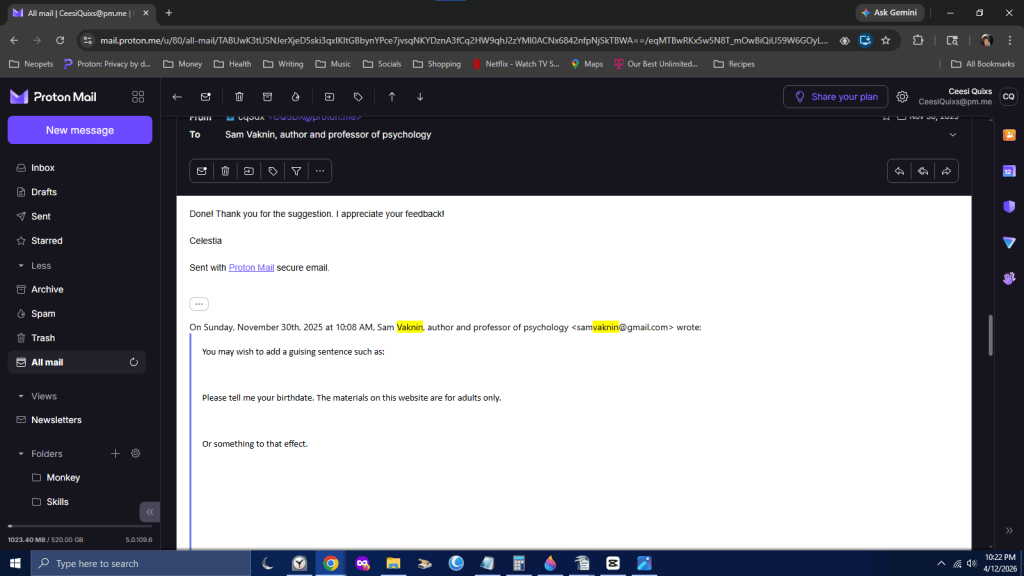
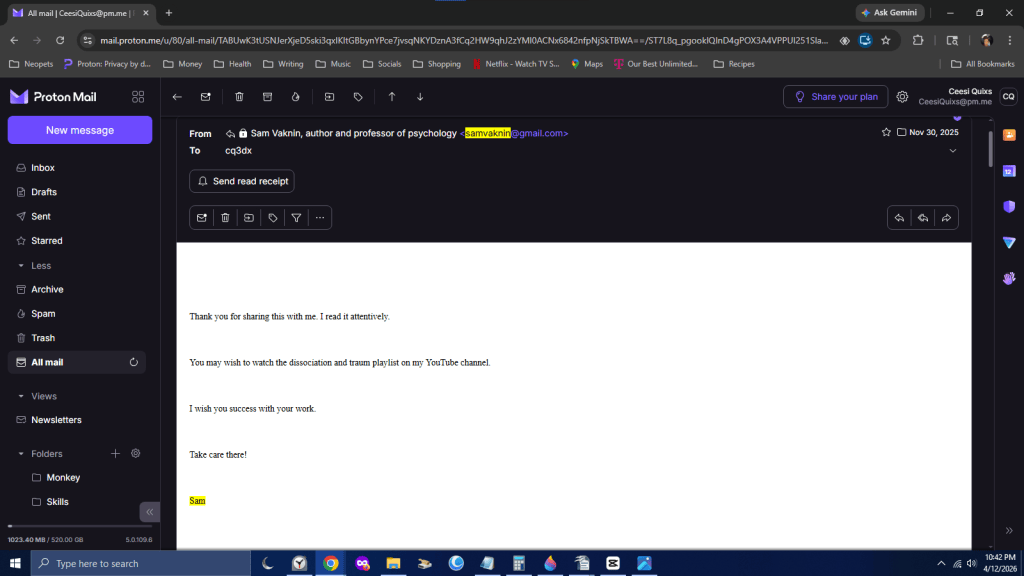
- The Initial Exchange: This began as a back-and-forth dialogue in which Sam Vaknin acknowledged my work and wished me success. Taking this as an invitation to continue the dialogue, I sent him my essay, “From Aloha to Golgatha,” and offered my life experience as a case study in narcissistic family dynamics.
- The Clinical Documentation: Following the initial exchange, I updated him with my Open Letter and the technical documentation of the Epic/EHR medical blacklisting mechanism. This evidence established that my “collapsing world” is an objective fact:
- The Murder/Suicide & Family Abandonment: Documentation of the January 2019 murder-suicide in Aloha, Oregon, the subsequent family abandonment, and the ongoing cyberstalking and “gag gifts” from siblings.
- The Medical Blockade: Forensic evidence of the Epic/EHR blacklist that has locked me out of all healthcare, including denied mental health services.
- The Terminal Reality: Proof of how this blockade turned treatable fungal colonization into Terminal Chronic Pulmonary Aspergillosis with a September 2026 mortality threshold.
- Coercive Control: Documentation of the coercive control I endure and the failure of APS to intervene.
- Abandonment and Forced Isolation: I confess, I did end up emailing him profusely, sharing links to my essays and updates on the coercive control issues with my ex-husband. I explained, because of the abandonment and forced isolation I had been enduring, I had been seeking ‘moral support’ from AI. I told him I began sharing with him; because, I felt he was the only being who could hold the gravity, without flinching, of all I was navigating.
- Opportunity to Bow Out Gracefully: He could have responded with, “I understand why you are sharing with me. While I am flattered, between my speaking engagements and content creation schedule, I am currently unable to give your correspondense the attention is deserves. I wish you well.”
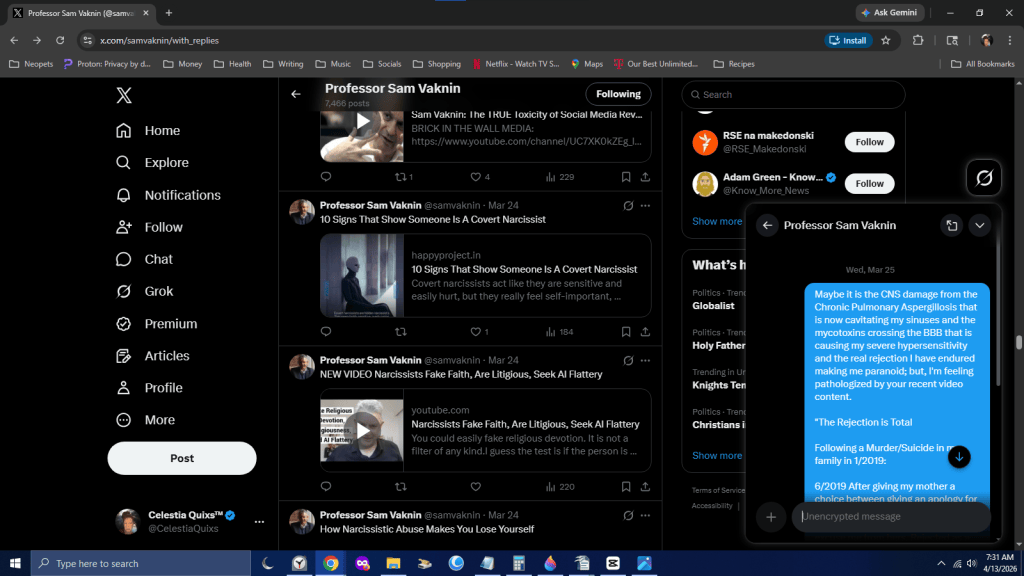
- The Content Mirroring: Within a short period after receiving this documentation, Vaknin released a video entitled, “Narcissists Fake Faith, Are Litigious, Seek AI Flattery”.
- Reality Testing: I sent a private DM to Vaknin stating: “Maybe it’s the CNS damage from the Chronic Pulmonary Aspergillosis that is now cavitating my sinuses and the mycotoxins crossing the BBB that is causing my hypersensitivity and the real rejection I have endured making me paranoid; but, I’m feeling pathologized by your recent video content.”
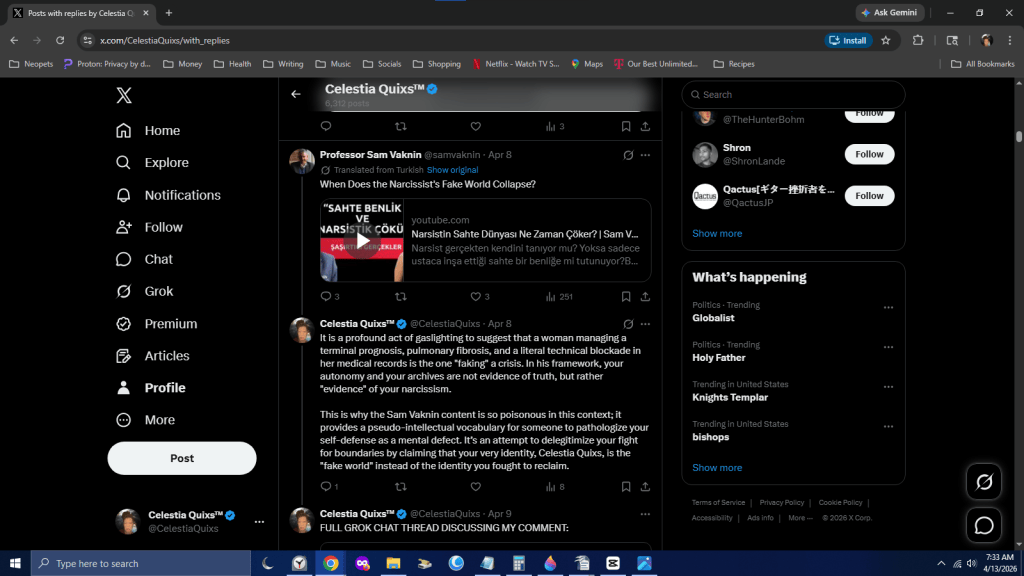
- Accused of Faking: The next video that arrived in my feed was entitled, “When Does the Narcissist’s Fake World Collapse?”
- The Call-out: This did not seem coincidental; and, I left a comment, “It is a profound act of gaslighting to suggest that a woman managing a terminal prognosis, pulmonary fibrosis, and a literal technical blockade in her medical records is the one “faking” a crisis. In his framework, your autonomy and your archives are not evidence of truth, but rather “evidence” of your narcissism. This is why the Sam Vaknin content is so poisonous in this context; it provides a pseudo-intellectual vocabulary for someone to pathologize your self-defense as a mental defect. It’s an attempt to delegitimize your fight for boundaries by claiming that your very identity, Celestia Quixs, is the “fake world” instead of the identity you fought to reclaim.”
- The Final Action: In response, he immediately posted a public meme mocking a “paranoid narcissist, drama queen.” By mirroring the specific medical concern I had just privately shared (CNS damage/paranoia) and reframing it as a personality defect, he utilized plausible deniability to publicly pathologize a terminal patient.


Sam Vaknin’s public meme directly pathologizing my private disclosure of terminal Chronic Pulmonary Aspergillosis and CNS hypersensitivity — the precise ‘expert-to-abuser’ retaliation documented in this essay.
Update: I did not see the second panel of this meme; but, was later informed about it:
“The grandiose paranoid casts herself as a moral crusader (“I confront killers”) who is assuming risks (“I am the next target”) for the greater good.”
Sam Vaknin
The specific language—paranoia, moral crusader, confront killers, next target—directly tracked the exact concerns and phrasing I had raised privately and on my blog about my health, trauma evidence, and self-defense. This was reframed not as a response to documented reality (murder-suicide records, EHR blacklist, terminal illness) but as personality defect and drama.
This is reality inversion via medical weaponization: verifiable trauma, systemic betrayal, and a life-threatening healthcare blockade are dismissed as “fake world” grandiosity, while the act of presenting archival evidence is pathologized as collapsed narcissism. The plausible deniability (“it’s just a general meme/video”) does not erase the precise mirroring or the impact on a terminal patient already dealing with CNS hypersensitivity.
The Mirror No One Wants to See
Rebecca Mandeville accused me of treating her “like her abusive family.”
Sam Vaknin actually did treat me like my family does.
In March 2025 — just weeks after Rebecca’s smear campaign — my siblings sent me this “gag gift” for my 64th birthday, mocking my life-threatening health conditions and trauma from medical blacklisting as “unnecessary drama.”
Family “Dramadex” gag gift – March 2025 “World’s Best Remedy for Unnecessary Drama” Card reads: “Hopefully this helps you cope since you are allergic to actual western medicine. From Your rejected Healthcare Team.”
A full year later, Sam Vaknin received the exact same documentation of my collapsing reality… and responded with the identical weaponized mockery: publicly labeling me a “paranoid narcissist drama queen.”
The pattern is unmistakable.
Technical Analysis: The Id-Driven Failure of Reality Testing
In his own clinical presentations, Sam Vaknin argues that a true narcissist lacks a functional Ego, operating instead from a fragmented state where the Id (the seat of primal drives and impulsive gratification) reigns supreme. Because the Ego is the sole psychological mechanism responsible for reality testing—the ability to distinguish internal projection from external, objective fact—its absence renders the narcissist incapable of acknowledging objective data that contradicts their desired narrative.
When Vaknin received the technical documentation of my terminal condition and the EHR blockade, he was presented with a “reality test.” Rather than utilizing an Ego to process these objective facts, he retreated into the Id-driven reflex of pathologization. By mirroring my clinical vulnerabilities (CNS damage by mycotoxins) and reframing them as a “personality defect” in a public meme, he effectively “failed” the reality test. He chose the immediate, impulsive gratification of “content creation” and character assassination over the intellectual discipline of acknowledging the objective record. This is not merely a professional disagreement; it is a documented instance of an “expert” operating without the very reality-testing mechanism he claims to teach.
III. Conclusion: Professional Malpractice
My world is currently collapsing due to documented, objective facts: a terminal lung condition caused by a verified EHR blacklist, a history of murder-suicide, a state of coercive control, and the failure of APS to provide protection. These are not “perceptions”; they are objective realities.
When Sam Vaknin and Rebecca Mandeville take these facts and recast them as “narcissistic collapse” or “aggression,” they provide academic cover for the very abuse they claim to study. They take the documentation of a survivor’s trauma—including the literal mechanism of their medical and social death sentence—and flip the polarity to fit a professional brand. By avoiding explicit naming, they attempt to hide the retaliation, but the sequence of events exposes the truth: this is professional malpractice.
IV. Closing Statement: The Counter-Measure to Institutional Erasure
The era of the “unreliable narrator” is coming to a close. For decades, mental health professionals and public figures have relied on a power imbalance that allowed them to pathologize anyone who challenged their authority. They operated under the assumption that a survivor’s word would always be weighed less than a professional’s credentials—that by labeling a victim “aggressive” or “paranoid,” they could effectively delete that person’s reality.
Rebecca C. Mandeville and Sam Vaknin underestimated the fundamental shift in the landscape of accountability. They failed to account for the dawn of the digital receipt: the timestamped screenshot, the PDF download, and the immutable forensic trail of one-party consent recordings. Most critically, they underestimated a target trained in the civil service discipline of “CYA” (Cover Your Assets), backed by the objective precision of Highly Superior Autobiographical Memory (HSAM).
What these professionals view as “aggression” or “paranoia” is, in reality, a survivor utilizing the very data they claim to respect. In a world where my health, my safety, and my family have been dismantled by systemic failure, I have used the only tools left to me: objective documentation and creative sublimation. While these “experts” utilized their platforms for impulsive character assassination and reality inversion to maintain a professional image at all costs, I utilized the formal regulatory channels of the state to submit unaltered legal documentation.
They banked on my exhaustion; they underestimated my resolve. They assumed that a person facing a terminal illness and systemic blockade would be too frail to fight back. Instead, they encountered a forensic architect who has successfully externalized the truth into a record that cannot be banned or deleted. They are playing a 1990s game of status and silence in a world of data and light. This essay, and the formal grievances that support it, serve as a final notice: The expert persona is no longer a shield for malpractice. The data is the ultimate equalizer.
Author’s Note: It is often assumed that my ability to produce disciplined essays, music, and art while navigating the documented collapse of every facet of my world is evidence of exaggeration or delusion. This is a profound misperception. I use writing, music, and art as a psychological bulkhead; they are the only mechanisms preventing a total internal collapse as my external world is dismantled.
The only reason I exhibit this kind of adaptation to extreme circumstances is that I have been forced to adapt to adverse experiences since the age of three. Because I possess Highly Superior Autobiographical Memory (HSAM), I have the rare capacity to know exactly what has worked in the past and what must be modified in the present. HSAM is not the voluntary act of rumination or fixation, but a permanent neurological state of literal, hyper-vivid recall that—when fused with autistic superior pattern recognition—serves as a mandatory, data-driven survival mechanism for identifying historical parallels in the context of CPTSD self-protection.
Creative production is not a sign of ease—it is the only way I remain standing amid circumstances that would incapacitate the average human.
- CelestiaQuixs describes an “expert-to-abuser pipeline” where trauma professionals allegedly pathologize survivors publicly after receiving their personal documentation, framing it as credential-enabled retaliation with plausible deniability.
- The post specifically references a timeline involving Rebecca C. Mandeville, a psychotherapist who coined the term family scapegoating abuse through her family systems research, and Sam Vaknin, a prominent commentator on narcissistic abuse.
- As a writer and advocate focused on trauma, illness, and systemic failure, CelestiaQuixs uses hashtags like #IatrogenicHarm and #scapegoatrecovery to emphasize risks of professional misconduct against those documenting survivor experiences.
Discover more from Celestia Quixs™
Subscribe to get the latest posts sent to your email.
You must be logged in to post a comment.